camelCase vs snake_case: Which Should You Use?
An honest comparison of camelCase and snake_case: how they work, which languages prefer which, and when to pick one over the other.
- naming conventions
- camelcase
- snake case
- programming style
- code style
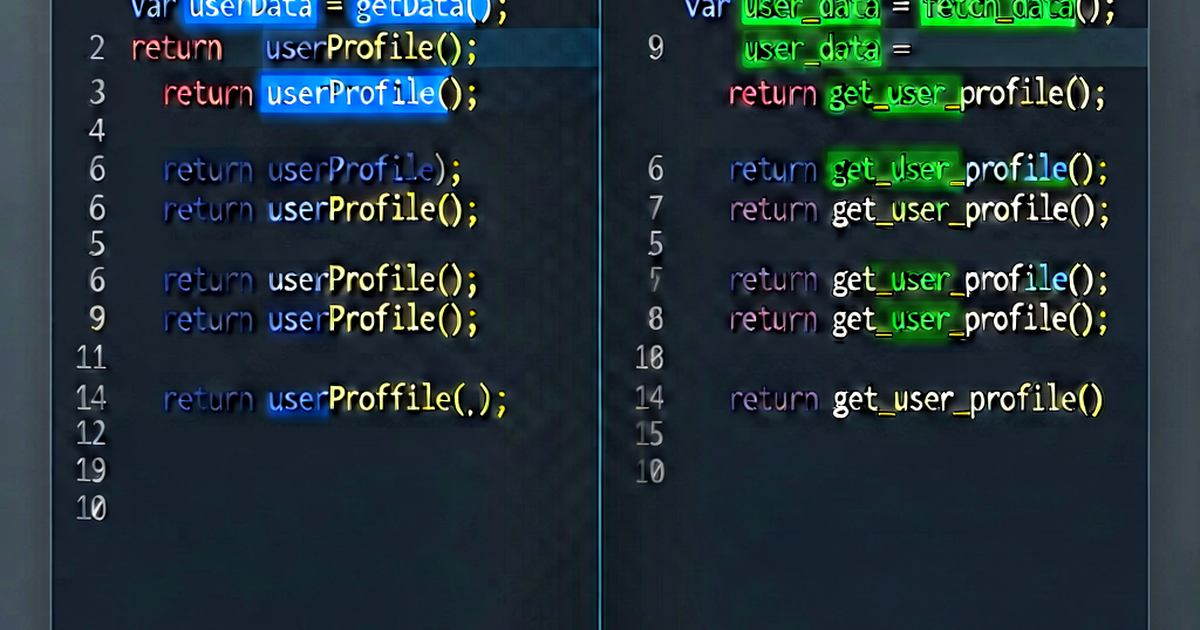

Naming conventions seem like a minor detail until you’re in a code review arguing about userId vs user_id. The good news: this debate has mostly settled answers, and knowing them saves you the argument.
What is camelCase?
camelCase writes multi-word identifiers by capitalizing the first letter of each word after the first, with no separators:
firstName
getUserById
isActiveAccount
maxRetryCount
The lowercase first variant (firstName) is called lower camelCase or just camelCase. The uppercase first variant (FirstName) is called upper camelCase or PascalCase — more on that distinction below.
The name comes from the humps formed by the capital letters in the middle of words.
What is snake_case?
snake_case writes multi-word identifiers entirely in lowercase, separated by underscores:
first_name
get_user_by_id
is_active_account
max_retry_count
The “snake” in the name refers to the low, flat profile of the text. A variant with all uppercase letters — MAX_RETRY_COUNT — is called SCREAMING_SNAKE_CASE or UPPER_SNAKE_CASE, and is standard for constants in many languages.
Which languages use which?
Convention varies by language, and deviation from the norm reads as unidiomatic even if it’s technically valid:
| Language | Variables/functions | Classes | Constants |
|---|---|---|---|
| JavaScript / TypeScript | camelCase | PascalCase | UPPER_SNAKE |
| Python (PEP 8) | snake_case | PascalCase | UPPER_SNAKE |
| Ruby | snake_case | PascalCase | UPPER_SNAKE |
| Go | camelCase (unexported) / PascalCase (exported) | — | PascalCase |
| Java | camelCase | PascalCase | UPPER_SNAKE |
| C# | camelCase (private) / PascalCase (public) | PascalCase | PascalCase |
| Rust | snake_case | PascalCase | UPPER_SNAKE |
| PHP | camelCase or snake_case (mixed ecosystem) | PascalCase | UPPER_SNAKE |
| Swift | camelCase | PascalCase | camelCase |
| Kotlin | camelCase | PascalCase | UPPER_SNAKE |
Rule of thumb: Follow the convention of the language and its dominant frameworks. Consistency within a codebase matters more than cross-language uniformity.
Where else do the conventions appear?
Beyond variable names, each style shows up in specific contexts:
kebab-case (hyphens instead of underscores) is the standard for:
- HTML attributes and custom element names
- CSS class names and custom properties (
--color-primary) - URL slugs and route paths (
/user-settings/security) - File names in web projects (
my-component.tsx)
snake_case is standard for:
- Database column names (
created_at,user_id) - Python, Ruby, and Rust identifiers
- Environment variables (as UPPER_SNAKE:
DATABASE_URL) - JSON keys in some APIs (especially Python/Ruby backends)
camelCase is standard for:
- JavaScript and TypeScript identifiers
- Java and Swift identifiers
- JSON keys from JavaScript/Node.js backends
- GraphQL field names
The readability argument
A common question: which is more readable?
Research on code readability is limited, but the most-cited study (Bonita Sharif and Jonathan Maletic, 2010) found that snake_case was faster to read when participants were unfamiliar with either style. However, the effect was small, and experienced programmers showed no meaningful difference.
In practice, readability comes from consistency, not the specific style. Code that mixes getUserId, get_user_id, and GetUserId in the same file is harder to scan than code that picks one and sticks with it.
PascalCase — the third convention
Upper camelCase (PascalCase) is worth calling out separately because it’s nearly universal for class names across languages:
class UserAccount {}        // Java, JS, TS, C#
class UserAccount:          # Python, Ruby
type UserAccount struct {}  // Go (exported)
struct UserAccount {}       // Rust
If your team debates UserAccount vs user_account for class names, the answer is almost always PascalCase regardless of language.
When you have a choice
Some contexts — JSON API keys, configuration files, database schemas — don’t have a hard language mandate. A few factors to weigh:
- Who consumes the output? If your API is consumed by JavaScript clients, camelCase keys save them a transformation step. If consumed by Python or Ruby, snake_case is more natural.
- Are there existing conventions? Extending an existing API or schema usually means matching it, even if you’d choose differently from scratch.
- Tooling support? ORM libraries, serializers, and linters often have default conventions. Going with the grain reduces configuration.
Quick reference
| Style | Example | Common use |
|---|---|---|
| camelCase | firstName | JS/TS/Java variables, JSON keys (JS) |
| PascalCase | FirstName | Classes everywhere, Go exported names |
| snake_case | first_name | Python/Ruby/Rust vars, DB columns |
| UPPER_SNAKE | FIRST_NAME | Constants, environment variables |
| kebab-case | first-name | URLs, CSS classes, HTML attributes |
Convert between styles online
If you’re migrating a codebase or working across language boundaries, the caseconvert.io converter handles all five styles and processes entire blocks of text at once.

Related reading
-
Naming Conventions in Programming: The Complete Guide
camelCase, snake_case, PascalCase, kebab-case — which applies where, and why it matters. Covers all major languages and contexts.
-
camelCase to snake_case in Python: Four Approaches
Convert camelCase strings to snake_case in Python using regex, str.join, or libraries. Includes code you can paste directly.
-
camelCase to snake_case in JavaScript: Three Clean Solutions
Convert camelCase identifiers to snake_case in JavaScript using regex, reduce, or a utility library. Includes edge-case handling for abbreviations.