Naming Conventions in Programming: The Complete Guide
camelCase, snake_case, PascalCase, kebab-case — which applies where, and why it matters. Covers all major languages and contexts.
- naming conventions
- programming style
- code quality
- camelcase
- snake case
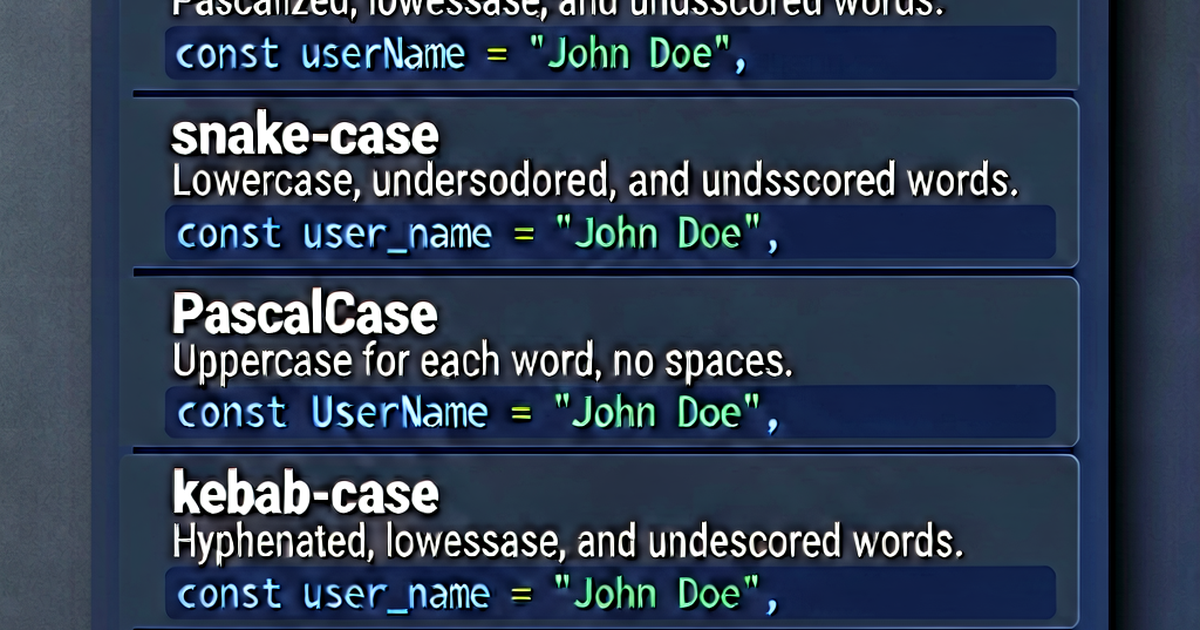

Naming conventions are the unwritten rules that determine whether your code looks like it belongs in a codebase or was imported from a different language. Getting them right is part of professional software development — not pedantry.
This guide covers the five main styles, where each is standard, and the edge cases worth knowing.
The five styles at a glance
| Style | Example | Pattern |
|---|---|---|
| camelCase | firstName | Lower first word, capitalize subsequent words |
| PascalCase | FirstName | Capitalize every word, no separator |
| snake_case | first_name | All lowercase, underscore separator |
| UPPER_SNAKE | FIRST_NAME | All uppercase, underscore separator |
| kebab-case | first-name | All lowercase, hyphen separator |
camelCase
camelCase is the dominant style in JavaScript, TypeScript, Java, Swift, and Kotlin for variable and function names.
// JavaScript
const firstName = 'Alice';
function getUserById(userId) { ... }
const isActiveAccount = true;
// Java
String firstName = "Alice";
public User getUserById(int userId) { ... }
boolean isActiveAccount = true;When to use it:
- Variables and function/method names in JS, TS, Java, Swift, Kotlin
- JSON keys from JavaScript backends
- GraphQL field names
- Object properties in JS/TS
PascalCase (Upper CamelCase)
PascalCase differs from camelCase only in that the first word is also capitalized. It’s nearly universal for class and type names:
class UserAccount:          # Python
    ...

class UserAccount { }       // Java, C#, JS/TS

type UserAccount struct { } // Go (also for exported functions)

struct UserAccount { }      // Rust
When to use it:
- Class names in every mainstream language
- TypeScript interfaces and type aliases
- React components (
<UserCard />) - Go exported functions and variables (
GetUservsgetUser) - C# public members
snake_case
snake_case is the standard in Python, Ruby, Rust, and for database column names.
# Python (PEP 8 mandated)
def get_user_by_id(user_id: int) -> User:
    max_retry_count = 3
    is_authenticated = False
-- SQL (conventional)
SELECT user_id, first_name, created_at
FROM user_accounts
WHERE is_active = TRUE;When to use it:
- All identifiers in Python and Ruby
- Variables and functions in Rust
- Database table and column names
- API keys from Python/Ruby backends
- File names in Python projects (
my_module.py)
UPPER_SNAKE_CASE
UPPER_SNAKE is snake_case with all letters capitalized. It universally signals “constant” — something that should not be mutated:
# Python
MAX_CONNECTIONS = 100
DATABASE_URL = "postgres://localhost/mydb"
SECRET_KEY = "abc123"
# Shell / environment variables
export DATABASE_URL="postgres://localhost/mydb"
export SECRET_KEY="abc123"// JavaScript (const + uppercase signals semantic constant)
const MAX_RETRY_COUNT = 3;
const API_BASE_URL = 'https://api.example.com';When to use it:
- Named constants in Python, Ruby, Rust, C, C++
- Environment variable names (always)
- Enum values in some languages (Java, C# use PascalCase instead)
kebab-case
kebab-case uses hyphens instead of underscores. It’s the style for web-facing contexts where underscores have different semantics or lower readability:
/* CSS */
.user-card { }
.is-active { }
--color-primary: #0070f3;
<!-- HTML custom elements and attributes -->
<my-component data-user-id="42"></my-component>/user-settings/security
/blog/how-to-format-jsonWhen to use it:
- CSS class names and custom properties
- HTML attribute names (data-, aria-)
- URL slugs and route paths
- File names for web projects (
user-card.tsx,get-started.md) - npm package names (
lodash,change-case,react-dom) - CLI flags (
--dry-run,--output-file)
kebab-case cannot be used as an identifier in most programming languages (the hyphen is a subtraction operator), so it’s limited to contexts where identifiers are strings or paths.
Language cheat sheet
| Language | Variables/Functions | Classes | Constants | Files |
|---|---|---|---|---|
| JavaScript | camelCase | PascalCase | UPPER_SNAKE | kebab-case |
| TypeScript | camelCase | PascalCase | UPPER_SNAKE | kebab-case |
| Python | snake_case | PascalCase | UPPER_SNAKE | snake_case |
| Ruby | snake_case | PascalCase | UPPER_SNAKE | snake_case |
| Java | camelCase | PascalCase | UPPER_SNAKE | PascalCase |
| C# | camelCase (private) | PascalCase | PascalCase | PascalCase |
| Go | camelCase / PascalCase | — | PascalCase | snake_case |
| Rust | snake_case | PascalCase | UPPER_SNAKE | snake_case |
| Swift | camelCase | PascalCase | camelCase | PascalCase |
| PHP | camelCase or snake_case | PascalCase | UPPER_SNAKE | PascalCase |
| CSS | kebab-case | — | — | kebab-case |
| SQL | snake_case | — | — | snake_case |
Cross-boundary conversions
The most common source of bugs from naming conventions is at serialization boundaries — where your backend language meets your frontend, or where your app meets a database.
Python backend + JavaScript frontend:
- Python produces
user_id,first_name(snake_case) - JavaScript expects
userId,firstName(camelCase) - Solution: use a serializer alias (Pydantic’s
alias_generator, Django REST Framework’sCamelCaseJSONParser) or transform in the client
JavaScript API + PostgreSQL:
- Postgres uses snake_case columns (
user_id) - JavaScript uses camelCase (
userId) - Solution: configure your ORM (Knex
camelizeKeys, Prisma default camelCase mapping) to handle conversion automatically
Go exported names + JSON:
- Go exports
UserID(PascalCase) - JSON convention for JavaScript clients is
userId(camelCase) - Solution:
json:"userId"struct tags
Consistency over correctness
Within a codebase, consistency matters more than following conventions exactly. A Python project that’s been using camelCase for five years should not switch halfway through. A new project should follow the language convention from day one.
Linters enforce this:
- ESLint
camelcaserule for JavaScript pylint/pycodestylefor Python (enforces PEP 8)golint/staticcheckfor Gorustfmtfor Rust (formats but also catches naming warnings)rubocopfor Ruby
Convert between styles
Need to rename a block of identifiers from one style to another? The caseconvert.io converter handles camelCase, PascalCase, snake_case, UPPER_SNAKE, and kebab-case — paste your identifiers and get the output instantly.

Related reading
-
camelCase vs snake_case: Which Should You Use?
An honest comparison of camelCase and snake_case: how they work, which languages prefer which, and when to pick one over the other.
-
camelCase to snake_case in Python: Four Approaches
Convert camelCase strings to snake_case in Python using regex, str.join, or libraries. Includes code you can paste directly.
-
camelCase to snake_case in JavaScript: Three Clean Solutions
Convert camelCase identifiers to snake_case in JavaScript using regex, reduce, or a utility library. Includes edge-case handling for abbreviations.