What Is snake_case? A Practical Guide for Developers
snake_case explained: how it works, where it's used, and why Python, Ruby, and databases default to it. Includes comparison with camelCase and kebab-case.
- snake case
- naming conventions
- programming style
- python
- databases
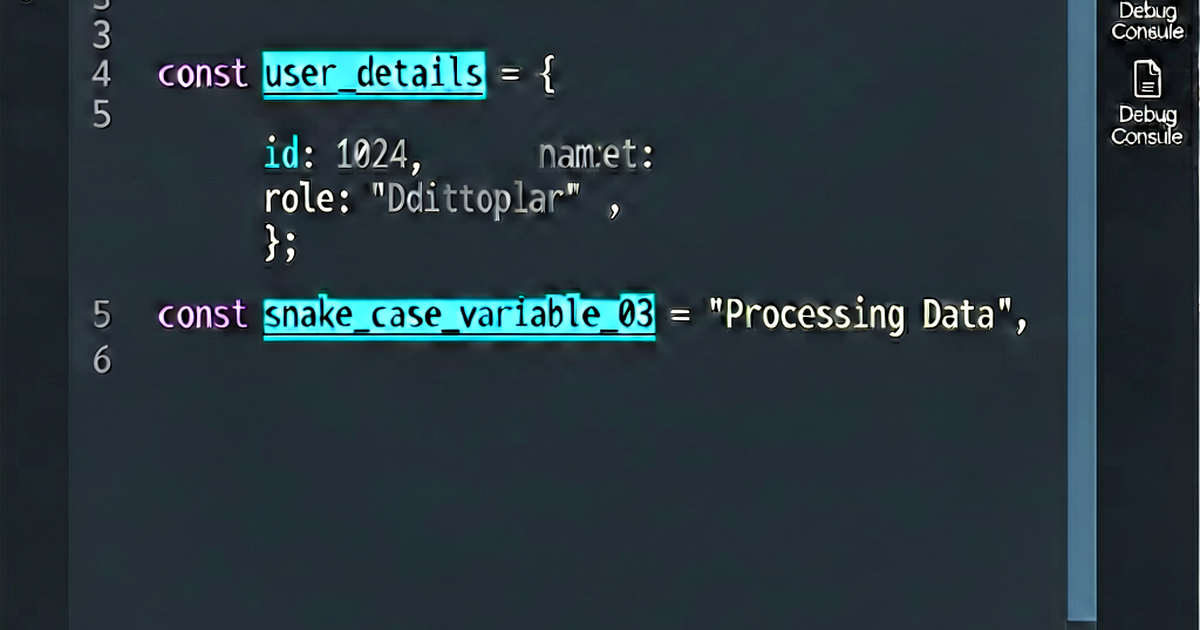

snake_case is a naming style that writes multi-word identifiers entirely in lowercase, with underscores between words:
user_id
first_name
get_user_by_id
max_retry_count
is_active
The name comes from the visual: the underscores make text look like it’s slithering along the ground like a snake.
What makes a valid snake_case identifier?
- All letters are lowercase
- Words are separated by single underscores
- No spaces, hyphens, or capital letters
- Numbers are allowed anywhere:
user_v2,http_200_response - Leading underscores are a convention for “private” in Python:
_internal_func - Double leading underscores invoke name mangling in Python classes:
__private
These are not snake_case:
First_Name    ← capital letter
user-id       ← hyphen, not underscore (that's kebab-case)
userID        ← camelCase, no underscore
User_ID       ← mixed case
Where snake_case is the standard
Python — PEP 8, the official Python style guide, mandates snake_case for all function names, method names, and variables:
def get_user_by_id(user_id: int) -> User:
    ...

max_connections = 10
is_authenticated = False
Classes use PascalCase; constants use UPPER_SNAKE_CASE.
Ruby — Ruby follows the same convention: methods and variables are snake_case, classes are PascalCase:
def send_welcome_email(user_id)
  ...
end

active_users = User.where(active: true)
Rust — Rust enforces snake_case at the compiler level. A variable named myVar triggers a warning; my_var is correct:
fn get_user_by_id(user_id: u64) -> User {
    ...
}

let max_retry_count = 3;
SQL and database columns — snake_case is the dominant convention for column and table names across PostgreSQL, MySQL, and SQLite:
CREATE TABLE user_accounts (
    user_id       SERIAL PRIMARY KEY,
    first_name    TEXT NOT NULL,
    last_name     TEXT NOT NULL,
    created_at    TIMESTAMPTZ DEFAULT NOW()
);
Some ORMs (Django, ActiveRecord) generate snake_case column names automatically from PascalCase model names.
Environment variables — UPPER_SNAKE_CASE (a variant) is the standard for environment variable names:
DATABASE_URL=postgres://localhost/mydb
SECRET_KEY=abc123
MAX_CONNECTIONS=20
Where snake_case is not the standard
- JavaScript/TypeScript — camelCase for variables, PascalCase for classes
- Java — camelCase for variables and methods, PascalCase for classes
- Go — camelCase for unexported names, PascalCase for exported
- CSS — kebab-case for class names and custom properties
- URL paths — kebab-case (
/user-settings) is preferred over snake_case
snake_case vs camelCase vs kebab-case
| Style | Example | Standard use |
|---|---|---|
| snake_case | user_id | Python, Ruby, Rust, SQL |
| camelCase | userId | JavaScript, TypeScript, Java |
| PascalCase | UserId | Classes in most languages |
| UPPER_SNAKE | USER_ID | Constants, environment variables |
| kebab-case | user-id | CSS, HTML, URLs |
The distinction matters at API boundaries. A Python backend that exposes user_id and a JavaScript frontend that expects userId need explicit conversion — either in the serializer or the client. Libraries like humps (Python) or change-case (JavaScript) handle this.
Why Python chose snake_case
Guido van Rossum’s original rationale (captured in PEP 8 and various Python mailing list posts) was that snake_case reads more like natural English, particularly for longer identifiers. get_user_by_id parses as four distinct words; getUserById requires training your eye to find the word boundaries.
It’s partly a historical accident: Python emerged in a Unix/C context where underscored identifiers were common. JavaScript emerged from a Java/ECMAScript context where camelCase was already the norm.
UPPER_SNAKE_CASE for constants
When you want a constant in Python, Ruby, or Rust, the convention is snake_case with all letters uppercased:
MAX_CONNECTIONS = 100
DEFAULT_TIMEOUT = 30
API_BASE_URL = "https://api.example.com"
In Python, UPPER_SNAKE doesn’t technically prevent mutation (unlike const in JavaScript), but the convention signals intent to other developers.
Convert between styles
Working across a Python backend and a JavaScript frontend? The caseconvert.io tool converts identifiers between snake_case, camelCase, PascalCase, and kebab-case — paste a block of identifiers and get the converted output instantly.

Related reading
-
camelCase vs snake_case: Which Should You Use?
An honest comparison of camelCase and snake_case: how they work, which languages prefer which, and when to pick one over the other.
-
camelCase to snake_case in Python: Four Approaches
Convert camelCase strings to snake_case in Python using regex, str.join, or libraries. Includes code you can paste directly.
-
Naming Conventions in Programming: The Complete Guide
camelCase, snake_case, PascalCase, kebab-case — which applies where, and why it matters. Covers all major languages and contexts.